Showing posts with label Amani Willett. Show all posts

3.20.2015

Exchange Edit: Amani Willett by Dan Boardman

Exchange edit is a series in which two photographers select images from the various bodies of work of the other photographer and then sequence them to form a new edit.

Today we present the work of Amani Willett edited and sequenced by Dan Boardman. Yesterday we presented the work of Boardman edited and sequenced by Willett.

Amani Willett's monograph Disquiet was published in the spring of 2013 by Damiani. He was recently featured in the books Street Photography Now (Thames and Hudson) and New York: In Color (Abrams). Willett's pictures have been exhibited both nationally and internationally, including at the Howard Greenberg gallery and his work has been featured in such publications as American Photography, Newsweek and The New York Times. He has given talks about his work at institutions including the International Center of Photography. Willett received his MFA in Photography, Video and Related Media from the School of Visual Arts.

Amani currently lives in Brooklyn with his family.

Dan Boardman is an artist living and working in Gloucester, Massachusetts. Dan's photographs are often collected into handmade artist books that draw from a panoply of influences from Richard Feynman to Flannery O'Connor. In 2012 Dan received his MFA from the Massachusetts College of Art and Design (MassArt). He has taught at Harvard University, Boston University and MassArt. He is currently a Visiting Assistant Professor at MassArt. In 2013 he was awarded a Mass Cultural Council Grant for photography. Recently his work was exhibited at Harvard University, The Mills Gallery and Aviary Gallery. In addition to his own photography, Dan runs a publishing company called Houseboat Press.
______________________________


3.19.2015

Exchange Edit: Dan Boardman by Amani Willett

Exchange edit is a series in which two photographers select images from the various bodies of work of the other photographer and then sequence them to form a new edit.

Today we present the work of Dan Boardman edited and sequenced by Amani Willett. Tomorrow we will present the work of Willett edited and sequenced by Boardman.

Dan Boardman is an artist living and working in Gloucester, Massachusetts. Dan's photographs are often collected into handmade artist books that draw from a panoply of influences from Richard Feynman to Flannery O'Connor. In 2012 Dan received his MFA from the Massachusetts College of Art and Design (MassArt). He has taught at Harvard University, Boston University and MassArt. He is currently a Visiting Assistant Professor at MassArt. In 2013 he was awarded a Mass Cultural Council Grant for photography. Recently his work was exhibited at Harvard University, The Mills Gallery and Aviary Gallery. In addition to his own photography, Dan runs a publishing company called Houseboat Press.

Amani Willett's monograph Disquiet was published in the spring of 2013 by Damiani. He was recently featured in the books Street Photography Now (Thames and Hudson) and New York: In Color (Abrams). Willett's pictures have been exhibited both nationally and internationally, including at the Howard Greenberg gallery and his work has been featured in such publications as American Photography, Newsweek and The New York Times. He has given talks about his work at institutions including the International Center of Photography. Willett received his MFA in Photography, Video and Related Media from the School of Visual Arts.

Amani currently lives in Brooklyn with his family.
______________________________


1.12.2015

Classroom: Andrés Sánchez

© Andrés Sánchez, Image 1


fototazo began a mentorship program in 2012, matching young Colombian photographers with mentors from across the spectrum of the photographic world - gallery owners, bloggers, academics, art directors and working photographers. The goal is to provide the young photographers with commentary and advice on their work from professionals in the field and to expand their network and knowledge of resources beyond Colombia.

The program started behind the scenes, but in an effort to create a singular conversation, share with readers work being made by the photographers and under the belief that the advice, insight and ways of talking about images offered by the mentors will be useful and interesting to other photographers, we are experimenting with making the process a public one.

We periodically feature a selection of images from a photographer involved in the program and comments from mentors. The current photographer and comments will be housed under the classroom tab above and older posts will be available through the site links page.

This post features the work of Andrés Sánchez - who was our 12th microgrant recipient - and comments from his assigned mentor, Amani Willett, as well as additional comments from Dawn Roe.

The image numbers in the text correspond to those below the images in the caption.
______________________________

© Andrés Sánchez, Image 2

Statement
My research work focuses on the search for the expression of pain, how to represent that feeling that is intangible and often inexpressible. My work also focuses on how the medical world objectifies the human body, how it analyzes, fragments, divides, classifies, encases, displays, invades, removes, transforms, wraps, sews and burns it, how it makes it sick and how it makes it better. Science does this and the body puts up with it, that is our times. But how do you do these things with the soul, the spirit? How do we paste a heart divided, how do we ensure that the pain of the heart does not kill other vital organs, leaving us spiritually crippled? How do we locate the most difficult pain to bear, the intangible, the diffuse (that we don’t know where it is exactly) as it gores from the tears to the chest and back up to the thoughts.

When the soul hurts, what?

When neglect hurts us, what do we do? And when are we forgotten? What can we take? Pills don't exist for negligence, or injections for heartbreak; that is what we would like, for happiness to come in strips of 12 units, in patches, or syrups in order to face the world. To kill physical pain many products exist, but for the soul nothing physical exists to help us heal it.

© Andrés Sánchez, Image 3

The project continues to grow and continues to change.

Questions for mentors
1- To what extent can I let my work take the course that it wants to take and when should I intervene to keep it on the path I always had in mind for it? I ask this because my photographs initially sought a kind of cure for my ailments, but the project has become a visual representation of what could be called pain.

2- What advice or opinions would you have about technical issues for me? For example: the lighting, color palette, textures, etc.

3- And finally, would you have any references for me to consider so I can continue enriching my base of technique and knowledge of other photographers?

Thank you,

Andrés Sánchez Muñoz
______________________________

© Andrés Sánchez, Image 4
Response from Amani Willett

Hi Andrés

Thank you for sharing your writing and your pictures with us – especially with what can be such a personal topic. It was a pleasure to read your statement and learn a bit about you. Jumping right in...

The way you have written your statement, I get the sense that you are staking out an intellectual or cerebral approach to your image-making - that you are trying to solve the problem of how to visually represent an intangible feeling. At the same time, there are a lot of other ideas you are trying to tackle with this project and it may be slightly too ambitious in its current scope. As an exercise, I'd try parsing down your statement to one or two sentences – this might help focus your ideas for now. Your ideas about the medical world are very interesting, but also could be a project of its own. I think it would be prudent to start the project by focusing on one idea - either trying to visually represent pain or examining how the medical world deals with the human body.  Once you have secured a good understanding of how you want to work with one of the ideas, there may be an opportunity to expand the scope of the work.

Many of the images you have shared with us are very strong - and quite striking.  In particular, the first three pictures begin to describe a world that is quite different from what I visualize when I think about hospitals and medical care. I love the perspective of the image of the light in the medical office, especially when juxtaposed with the image of the young man (you?) bathed in eerie light.  I'm very curious to know more about that portrait – was it made in a medical facility using the light from medical equipment?  That could be a terrific approach for the images in this series. That being said, overall, the pictures feel more emotionally driven than the mental picture I got from reading your statement.  I could very well have misinterpreted my reading of your statement.

© Andrés Sánchez, Image 5

© Andrés Sánchez, Image 6

© Andrés Sánchez, Image 7

As you work on this project, it will be useful to keep in mind that many photographers have tackled the subjects of personal pain, struggling, depression and the like. Some of the images in the middle and end of your series of images, while strong, are images that show pain in a way that I would expect or that I've seen before. Your challenge will be how to represent these ideas in a new way.

Similarly, as many photographers have photographed pain, there have also been many approaches taken to illustrate those ideas. I think if you start refining and defining your approach to your image-making, it will be helpful in advancing the project. Think about the best way to illustrate your ideas...do you want tackle this project from a personal narrative perspective, a journalistic perspective, a conceptual perspective, an abstract perspective, etc.

For example, in the images you have shared, I can see a few approaches being utilized, which I would loosely call personal narrative and conceptual. You could definitely continue along those lines as the project develops. As mentioned before, the challenge will be how to create images, and a narrative, that show a fresh and new take on the themes. Additionally, for personal narrative projects to be successful, they often involve having the courage to lay it all bare – being willing to share everything. A photographer to look at who does this well would be Elinor Carucci, especially the projects "Pain" and "Crisis."

© Andrés Sánchez, Image 8

Alternatively, you could approach the project from a more cerebral point of view, which would be in line with the first sentence of your artist statement. In this approach you could literally try and find ways to make images to represent something that are, in your words, "intangible, inexpressible." There is a strong tradition of photographers using the medium to try and capture that which is not able to be photographed and I think your project could also add nicely to that tradition. There was a recent group show on the Humble Arts Foundation site dealing with images that attempt to capture the spirit. It's not exactly the same topic, but I think the show will give you a lot of great ideas. It's called "Group Show 42: Occultisms."

I know you are also curious about how much to direct your work or let it run free. It's a tough question! I'm always a proponent of having the flexibility to let the work lead you where it wants to go – and you should definitely have that flexibility. At the same time, your statement contains some very specific and complicated ideas which will require a fair amount of discipline and attention. I don't know how long you have been working on the project to date, but if you have the time, I would definitely advocate taking a month or two to experiment with a lot of different ways you could express your ideas.

I hope this all helps. I'm very excited to see how the project develops. You have a lot of wonderful ideas and images already on the table!
_______________________________

© Andrés Sánchez, Image 9
Response from Dawn Roe

Dear Andrés,

I really enjoyed having the opportunity to look over your work, there are so many striking images within your series – I see a lot of potential here, and encourage you to keep thinking through your ideas as you push the project forward. My responses to each of your images (below) were written without referring back to your artist statement (which I had read about a month ago), and are based primarily on my response to how the images worked together as a group, and which images appeared strongest to me.

When I view this series, I am led to think of the conflict between modern medicine and personal belief systems (often based upon religious upbringing or shared cultural history). Ultimately, I read the strongest images as conveying a sense of the mysteries of the unknown and the internal, psychological pressures that accompany this – and perhaps how these aspects are amplified when the body is under physical stress due to illness or disease, sometimes confined to spaces that are unfamiliar or undesirable. I enjoy the ambiguity that is accentuated by the heavy, cool presence of the blue that dominates, and the dark spaces that suggest the unknown. Overall, there is a very clear sensibility that comes through strongly, but is best conveyed when a bit of restraint is shown in terms of the construction of the images and their visual treatment.

© Andrés Sánchez, Image 10

I agree with Amani's very insightful comments regarding your statement and also encourage you to spend time really considering the complex (and varied) nature of the content you purport to be exploring. I think the latter portion of your statement starts to get at what I, as a viewer, am seeing in your images. I think it would be useful to really consider how you are framing the work through language in relation to the visual actuality of the photographs. Sometimes the work shifts a bit as you are sorting it out – it may be that you've started the project with one idea, yet you are discovering new strands of ideas as the imagery and the ideas progress.  I think you should allow the work to run the course that feels natural to you.

As to your technical issues – you seem to be able to obtain the kind of mood/feeling that you hoping for with your treatment, just keep an eye on consistency in terms of cool/warm palettes – it's not that you can't combine the two, it should just seem purposeful. Be wary of unintended color casts. And, do try to pull out just a hint of information in some of the deep black areas so they don't read as complete voids (unless, of course, that is absolutely your intention) – same goes for the extreme highlight areas.

Below are my comments on the individual images –

#1 – Beautiful, rich blues – the slightly off kilter framing instills a certain amount of energy and activity – it's an active composition in this way. I also enjoy the delicacy of the embroidered curtain contrasting with the see-through quality of the fabric the figure is draped in – which only after a longer look begins to appear as though it is made of paper, as a hospital dressing gown would be.

#2 – Also strong, follows #1 nicely, but the lack of focus is a bit jarring following the very crisply detailed silhouette in #1. I do enjoy the movement present in the body in this image, and the function of the light toward the center of the image. Also, the gesture of the raised right arm with left hand pointing toward chest, and the downward gaze – a certain referencing of religious iconography is present. The very ambiguous patterned background almost reads like a projection as well, or an underwater space.

© Andrés Sánchez, Image 11

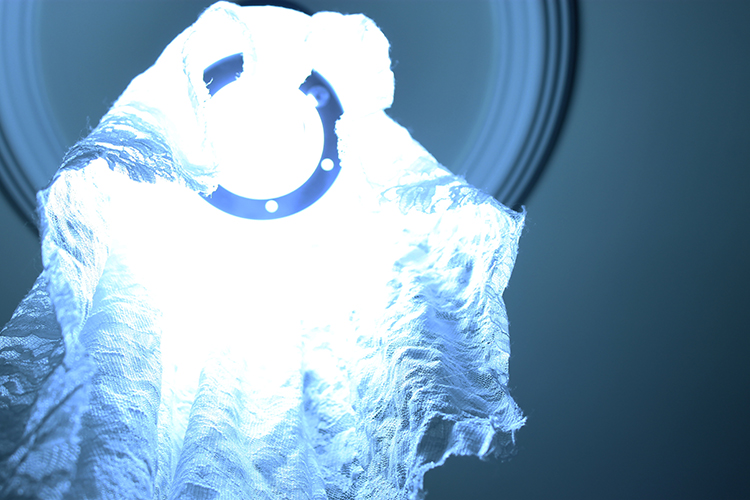
#3 – There is potential here, but the blown out highlights do not read as being purposefully handled in that manner. The texture in the fabric toward the bottom of the image – reading simultaneously like lace and gauze – works nicely, but the complete eradication of detail toward the top/middle is distracting to me. Perhaps you could work toward retaining the blinding glow of the device/light while still creating a richer print.

#4 – This image takes us out of an otherworldly/fantastic/dreamlike space into a much more "real" environment, due to the quality of light and lack of overwhelming blue hue – I'm not sure this image is as strong as the others as there is not as much to latch onto here, although I do enjoy the emotion conveyed from the sort of cowering figure. Perhaps there is another version of this image that would work better within the sequence.

#5 – This is a beautiful image that contains that same sort of airy quality that the blinding light in #3 could have. Here the lack of detail in the top is less important, as it suggests a certain emptiness. I appreciate how it feels as though the feet are floating upward – this image is teetering a bit close to a cliché in terms of "going into the light" but its minimal quality works in its favor (on a technical note – it might be worth fiddling around a bit with the color fringing that happens around the edges, just to make sure the image reads as you would like it too – a bit of a magenta/red cast creeping in).

#6- I enjoy this image, but in some ways it feels as though it belongs to another series. The interior space becomes the most important thing and the figure in the corner gets very lost. Compositionally, it's a little bit awkward as well, due to the framing of the silhouetted furniture in the foreground.

#7 – This one is not as strong for me, due to the warmth of the image (it is the only one in the series treated in this manner) and the lack of focus.

© Andrés Sánchez, Image 12

#8 – Really strong one here – I could almost see this closing the series. This has just the right amount of obscured and revealed information – and the ever so slight inclusion of just a bit of warmth along the arm contrasts so perfectly with the hazy blue/violet light surrounding. The inference of a wrought iron bed frame injects a nice bit of narrative as well, that lets the viewer conjure a certain type of space/place.

#9 – I'm immediately distracted by the green cast in this image, but it's also not nearly as strong as your others in terms of composition and art direction. There is too much specificity for me – the painted toenails, the curtain rod, the fruits on the fabric. I view this and immediately think of the image's construction.

© Andrés Sánchez, Image 13

#10 – This one I like, but again it's hovering pretty close to the edge of a literal representation of an idea/thought/feeling – I think as long as you are careful about where and how it is presented in the series, it will work. The way the light is falling on the feet is really nice and sets them off from the background – as well, the slice of hospital gown around the knees helps add just a bit of crucial detail that impacts the response. I also appreciate the cold feeling of the tile floor that is so present for me, and the allowance of the light emanating from the window to be seen (although, I also wonder how the image would read with the window excluded from the frame, and the light appearing on its "own").

#11 – This one is far too clinical for me, and very commercial looking. It's the only one of its kind (at this point). Might just be too direct and not necessary. Although, as an image on its own, I do appreciate the intensity of the focus on the needle's sharp point, and the composition itself. Perhaps if there were other images that highlighted the materials/tools/methodologies of these medical spaces, this could work – but ultimately you'll need to think about the direction/nature of the series as a whole. There is almost a sci-fi feeling that starts to come in when I view the ascending feet prior to this image and then see the needle. A particular kind of narrative starts to emerge, and I'm not sure that's what you are going for.

© Andrés Sánchez, Image 14

#12 – Not quite enough information in this image and a little too romantic for me – the beautiful, pouty lips and the head cocked off to the side read a bit more like a fashion ad than perhaps you are intending. Something kind of nice about the pattern on the body being produced by the shadow though (makes me think a bit of a confessional).

#13 – There is potential in this idea, perhaps, but this is again a bit more direct than some of your other more successfully ambiguous images. It does refer back to historical/religious painting again, which might be nice, but the lack of clear focus somewhere in the image is also a bit distracting.

#14 – Similar to #12, a bit too close to a fashion advertisement for me. As well, I can't tell if those are Christmas lights in/around the head or something else – it seems a bit inadvertently quirky. As well, it certainly visually refers to Jesus and the crown of thorns, but it's not clear why it would be represented in this way – at this point in the series (also, it doesn't contain the rich blue that seems to be such a large part of tying the series together).

#15 – This last one seems to be kind of a different version of the first image, and I find the first image more successful. Although I do appreciate the sort of "heavenly" light surrounding the figure in this image, as well as the very nicely rendered subtle movement of the hands, the inclusion of the upturned head and just slight amount of expression able to be discerned on the face is distracting and, again, a bit too literal for me.

Keep going!

Dawn Roe

© Andrés Sánchez, Image 15

10.31.2013

Classroom: Juliana Henao Alcaraz

© Juliana Henao Alcaraz, Days, photograph 10

fototazo began a mentorship program in 2012, matching young Colombian photographers with mentors from across the spectrum of the photographic world - gallery owners, bloggers, academics, art directors and working photographers. The goal is to provide the young photographers with commentary and advice on their work from professionals in the field and to expand their network and knowledge of resources beyond Colombia.

The program started behind the scenes, but in an effort to create a singular conversation, share with readers work being made by the photographers, and under the belief that the advice, insight, and ways of talking about images offered by the mentors will be useful and interesting to other photographers, we are experimenting with making the process a public one.

We will be featuring a selection of images from a photographer involved in the program and comments from mentors approximately once a month. 

This post features the work of Juliana Henao Alcaraz- who was our sixth microgrant recipient - and comments from her two assigned mentors, Amani Willett and Oliver Schneider, as well as additional comments from Jaime Permuth and Gwen Lafage.
______________________________

Juliana asked her mentors specifically for help looking at the three different projects she has been working on to judge how they stand so far as well as how much promise they offer for her moving forward. Her three statements as well as images and comments from the mentors follow. For length, only a selection of the over 30 images sent to the mentors are presented here.

© Juliana Henao Alcaraz, Traces of life and death / Granada, Antioquia, photograph 5

Project 1
Traces of life and death / Granada, Antioquia

Never before in Colombia had people lived through the destruction of a town of this size, never before had my eyes seen so many dead, never before had I seen so much fear.

Before everything was normal, the people went to church, went to the market, to the river, the children played in the courtyard, people went to the their small country houses...they lived.

Then we left. There were very few people left, all in silence. We got used to the fear. Then came the hatred, then after the hatred came hope ... We all move forward with strength and memory, looking to the future without forgetting the past. There is no peace, nor tranquility, nor happiness. There is still silence and sadness, but now with a little more hope than before.

© Juliana Henao Alcaraz, Blue, photograph 1

Project 2
Blue

Another world ...
You refuse the light completely,
You go clickety clack as if you’re going to crash,
Crackling in and out of the water,
you're somewhere else, you fly ...
Feel your living slowness
that takes you to magnificence and oblivion ...
You dye yourself in her: green, yellow, blue ...
You undo yourself in form and color,
in weight or in fragrance ...
You navigate the sky by going through the bottom,
Sky galaxies reflected
and the waves circle you in rays of light...
Listen to your heartbeat,
your skin becomes bejeweled by clear drops,
other bodies go by like they’re water,
fleeting water for your thirst,
that caresses you with a distant light
in an intimate and unique shadow ...
You dance as if you are air
do not talk, do not hear, do not breathe ...
Feel.

© Juliana Henao Alcaraz, Days, photograph 9

Project 3
Days

Eternal and timeless days. Days filled with strangers who become close to you upon meeting them…days filled with friends who become strangers. Days in which you see the same thing…days in which you see nothing. Days in which instead of seeing, you feel…days with luck.

Days.
_____________________________________________________________________

© Juliana Henao Alcaraz, Traces of life and death / Granada, Antioquia, photograph 1


© Juliana Henao Alcaraz, Traces of life and death / Granada, Antioquia, photograph 2


© Juliana Henao Alcaraz, Traces of life and death / Granada, Antioquia, photograph 3

Response from Amani Willett:

Hi Juliana –

I'm excited to be able to connect with you, see your work and offer what advice I can.

I began by reading your project descriptions without looking at any of the photographs. This was a fun exercise because I have never seen your work and I know very little about you.

After reading the project descriptions, I think the first one, Traces of Life and Death, sounds the most promising. In the description I can hear your voice and your passion. I could immediately tell that this is a subject that you feel very strongly about. In reading the description, I gained some insight into your history, your experiences, your fears, etc.

Besides the obvious connection and interest you have the subject, I also sense that Traces of Life and Death holds promise for the most interesting project possibilities. There are so many different ways you could approach the subject – landscapes, portraits, documents. etc. Or a combination of multiple approaches. I would say that this potential strength is also a potential weakness– it could quickly get overly-complicated, overwhelming or confusing.

The Blue project idea is fine, but I’ve seen many similar projects. You would need to figure out a way to set the series apart from other similar projects.

The third project Days might be too open-ended. It might not provide enough structure.

After reading the project descriptions I looked at the photographs. The three projects are at differing stages of completion. The most cohesive of the projects at this point is the Blue series. The images work together, they agree with the work statement and they are the strongest images. It could be relatively straightforward to continue working on this series to try and make some images that set it apart from other photographers who have photographed "swimmers," "water," and "blue." You should do some research to see what other artists have produced while tackling these themes.

I still think Traces of Life and Death has the most potential, but at this point it also probably needs the most work. The photographs don’t yet have the same power as the statement and they feel disconnected with one another. This project may require quite a large number of images to effectively illustrate your concept. You might want to consider incorporating historical images, old family images, landscapes, still lives, portraits, maps and oral histories.

You have many exciting and promising directions to explore and some of the images in this first batch are wonderful. I hope my comments are in some way helpful for you as you figure out which project to focus on. I can't wait to see how your work develops!

- Amani Willett

© Juliana Henao Alcaraz, Traces of life and death / Granada, Antioquia, photograph 4


© Juliana Henao Alcaraz, Traces of life and death / Granada, Antioquia, photograph 7


© Juliana Henao Alcaraz, Traces of life and death / Granada, Antioquia, photograph 9


© Juliana Henao Alcaraz, Traces of life and death / Granada, Antioquia, photograph 10


© Juliana Henao Alcaraz, Traces of life and death / Granada, Antioquia, photograph 12


© Juliana Henao Alcaraz, Traces of life and death / Granada, Antioquia, photograph 13

Response from Oliver Schneider:

Dear Juliana,

Thank you for showing us your beautiful work. I'll go on and comment on each series specifically.

Traces of life and death / Granada, Antioquia

It was a huge difference to just look at the pictures without having read your statement. That's a common problem with photography and especially with documentary photography: the context is very important. My own personal goal is to make pictures that go beyond the context and stand for themselves (which I haven't managed to reach yet by my own standards). You could try to let your pictures be free and stand by their own, but with the topic you chose still in mind. What I mean is: don't try to tell something specific, grab your camera and do more pictures and don't think about what the viewer might want to know or has to understand.

I can see that you don't want to do a traditionally told photo story about a village that has been destroyed. But I think you could be even more distant from the actual story and tell us more about your feelings and show us your observations. Strangely, the picture with the horse (number 5) still sticks in my mind. Maybe because of its strange angle and framing but also it seems to be your personal, subjective perspective. The surrealism of the picture gives the picture more reality, in my very humble opinion. It reminds me a little of the work by surrealistic artists like Luis Buñuel or Alejandro Jodorowsky. The picture with the cow (number 10) goes very well along with it and has the perfect balance of showing something but not everything and still holds its mystery.

The whole series would gain immensely if you would take out the first three pictures or better: redo them, try again in different lighting and/or perspective if you can't let them go. Find out what it is you wanted to take a picture of and try to catch it. In your case maybe I would propose to try taking black and white pictures, too, I can imagine it could be great and even stronger and more focussed than in color. I can imagine numbers 3, 5, 9, 10 and 12 could look great in black and white and would make a good series.

Some pictures, like numbers 3 and 4, seem to me like you were hiding to take them or you were in a rush. Maybe you could try to be more upfront or when taking pictures of people, try to ask them for permission. Believe me, I know how hard that is, I'm still hiding when I can which is still a problem for me. Also, the situation changes completely when they're aware you're taking a picture and that sucks, too, I know. Try to find your way of dealing with this, maybe go to a public event or make planed portraits at their homes. The expressive faces are fascinating and it would be great to see them more clearly.

I really like your style of writing the statements, it's great to try something different and I like poetry. I think poetry has a lot in common with good photography: it's a condensed feeling. I think the challenge to understand a poem is not so much the context and excessive additional information but how you understand and how you feel it personally. Certainly this is my personal opinion rooted in my taste in photography, others might see that differently.

Blue

I can relate to your fascination with water and to be underwater. You feel free and in a way out of this world. The numbed hearing and the shades of blue are indeed fascinating. Also, no wonder in medicine they use tanks to give people relief who suffer from Tinitus. To quiet down is also a big wish of mine, to find quiet and stillness in a stressful world. Unfortunately there are certain topics in photography that so many people have tried and used that it's hard to stand out - to say it more directly, they're a little overused. I'm working as a designer and I sometimes have to look for fitting images in stock photography collections like Getty Images. This work numbs me in a bad way and spoil photography sometimes because I get sarcastic from so much stereotypes.

To be honest, this series is not working for me so much, I like the more abstract pictures the best (numbers 2, 7, 9, 10). Try to reflect what it is that fascinates you and try to get to the root of it, get extreme and try different photographic techniques (using flash or long exposure, wrong colors, bad cameras etc.). Maybe the goal will become clearer while doing more work underwater. Maybe looking at works of other photographers or painters will give you more ideas about how to proceed and how to get it more personal and outstanding. Do you know the work of Daisuke Yokota? Your statement is great, I really like your text and I think I really get what you're after but I think this series needs some more work. But don't give up, please, it's just hard to do in a really good and unique way.

Days
Another great statement! The viewer doesn't really need the additional information from your statement but it adds to the experience. I really like the series, I just think the pictures number 4 and 9 fit in so well. In those pictures your view gets more distant and the pictures lose their intimacy and power. Other than that, they're really touching, youthful and exploring - a rush of experiences. Please continue, I'm looking forward to seeing more. This series might illustrate what I said to your Traces of life and death series, these pictures telling me nothing specific, but in general they're telling me so much more about you and your life. I can relate and I can feel your hopes and dreams and I get a glimpse of you.

So, I hope I could help you in any way, I really tried! ;) Please get in touch and comment if you feel like it.

Best wishes from Berlin,
Oliver

© Juliana Henao Alcaraz, Blue, photograph 2


© Juliana Henao Alcaraz, Blue, photograph 3


© Juliana Henao Alcaraz, Blue, photograph 4


© Juliana Henao Alcaraz, Blue, photograph 6


© Juliana Henao Alcaraz, Blue, photograph 7


© Juliana Henao Alcaraz, Blue, photograph 9


© Juliana Henao Alcaraz, Blue, photograph 10

Response from Jaime Permuth:

Hola Juliana,

I was very moved by the courage, faith and sensibility in the words you wrote to accompany your images. I grew up in Guatemala during my country's Civil War, a time of great social upheaval and bloodshed. Violence was part of our everyday existence as were censorship - and ultimately more damaging for an artist - self-censorship. It was painful to hear about your devastating experience and witnessing in Granada. I hope that photography can help you come to terms with that in some way.

Forgive me for having more questions than comments. I'm not sure what the timeline is on your different projects or if you are undertaking them simultaneously. Are these projects complete or in progress?

With regard to Traces:
How far away do you live from Granada these days? How are you approaching photographic production? When and how often do you return to make these photographs? What is it like for you to return? More context in your statement would be very helpful.

I agree with Amani that Traces has great potential as a project and with Oliver that it might work better in black and white. I also, agree with Amani that the images in Blue are your most adventurous and consistent thus far. In a sense these two projects are like the two sides of a coin: mourning and celebration, ying and yang.

As a photographer you learn in two basic ways: by looking at other images and by making images as often as you can.

Looking at other explorations of tragedy and exile might be helpful to you (Peress, Koudelka and Salgado to name a few) as well as past explorations of the joys of the aquatic world (Howard Schatz, David LaChapelle and Jill Greenberg in the commercial arena and Breath, a beautiful new project by Tomohide Ikeya).

Un abrazo,
Jaime

© Juliana Henao Alcaraz, Days, photograph 2


© Juliana Henao Alcaraz, Days, photograph 3


© Juliana Henao Alcaraz, Days, photograph 4

Response from Gwen Lafage:

Hola Juliana,

Thanks for sharing your work.

As opposed to Amani, I first looked at your photos seeing just the title of the series and then I read your statement, before looking again at the photos.

I believe that it is important to convey the message or illustrate the subject just with the photos first - the title should be enough to give a first vision of the work, the statement should then offer a deeper understanding.

At first glance, I think that Blue is the most comprehensive project. The statement is well written, the photos are consistent. But as mentioned by others this is not a very new or innovative approach so you should keep exploring the subject to better define your own voice. Your statement is full of poetry, but also reverie and solitude, so as much as I like the playfulness of some of the photos, I think you should probably explore more the reverie you describe in your statement - or work on the playfulness of photos 4 and 6 for example but then with a slightly different statement?

Regarding Traces of Life and Death, I saw at first a very literal translation of the title in the photos. And I didn't understand the consistency and the flow of images. But reading your statement gave me another perspective and I started to better understand some of the images, which is a good thing. This project definitely has a very strong potential. But I think you should search deeper to explore what you're feeling and how your photos expressed that. There is an emphasis on your statement on the "before" and the "after," maybe this is something you can work on and explore this "duality." Your statement is very profound while I believe the photos are often too superficial, too literal. Your statement is also a lot about the people, maybe getting closer to the people, adding some portraits while keeping looking at the landscape can create a better story.

Your last project Days has for me the best photos. I'm not sure about the entire consistency of the images, but for me there is definitely something here. I wouldn't worry about the consistency or even the title or statement of this project just yet. Probably because the subject is very open, the photos seem closer, truer to you and your life? It seems to me that maybe because the subject is a little vague, it didn't become a constraint and so the photos are more natural - taken more from your 'heart' than your head? The statement is once again well written, but I think it might be too open to really create a consistent project/story. I would keep shooting and worry about the edit in a later stage. Sometimes keeping things simple and just shooting what feels right for you is the best way to go.

Thanks again for sharing your photos - I look forward to seeing your work progressing!

Best,
Gwen Lafage

© Juliana Henao Alcaraz, Days, photograph 5


© Juliana Henao Alcaraz, Days, photograph 6