Showing posts with label Blake Andrews. Show all posts

12.04.2014

Reading Shortlist 12.4.14

From the post "84 Illegal Photographs That Urban Climbers Risked Their Lives To Take" Photo © Vitaliy Raskalov

The Reading Shortlist is an occasional post with an eclectic listing of recommended sites, readings and links. A recommendation does not necessarily suggest an agreement with the contents of the post. For previous shortlists, please visit the site links page.
______________________________

Blake Andrews, B, Hold still, this will only hurt a sec. Blake skews pretty much each and every photography site out there and describes you, dear reader, as South American, Midwestern or a lover of The Americans. We got off relatively unscathed comparatively.

Still from "The Mexican Suitcase"

The Art of Photography, The Mexican Suitcase. This made the rounds a while back, but I just got around to watching it. A video on the rediscovery of negatives from the Spanish Civil War by Robert Capa, Gerda Taro and David "Chim" Seymour. The site is a wealth of history and tech videos for your leisure time.

Jeremy Mohler, Temporary Art Review, With Our Mouths Closed. A critique of the conventional Artist Talk arrangement and suggestions on how to invigorate it.

Still from "Video Interview with Nicholas Nixon"

Fraenkel Gallery, Video Interview with Nicholas Nixon. Nixon talks through the making and the meaning of "The Brown Sisters" on the 40th anniversary of the beginning of the project.

Trevor Paglen, FotoMuseum Blog, Is Photography Over? The first of a five-part series examining the question of whether we have come to the end of photography.

Conor Risch, PDN Online, MoMA’s New Chief Photo Curator Turns to Studio Photography for First Show. Quentin Bajac talks about his first show on the MoMA based in studio photography, but more interestingly talks through some of the major issues confronting photographers, museums and curators today including the deluge of photographs, photobooks in museums and the "widening gap" between artistic and vernacular photography.

Ian Sample, Stuart Clark and James Randerson, The Guardian, Philae lander sends back first ever image from comet.

Alex Scola, Distractify, 84 Illegal Photographs That Urban Climbers Risked Their Lives To Take. Grasp desk firmly before opening link.

Andrea Zlotowitz, ArtSlant, Do We Need Galleries Anymore? The Utility of Online Exhibitions. A smart response to Jonathan Jones' asinine article in The Guardian, "Flat, soulless and stupid: why photographs don’t work in art galleries."


11.07.2014

Reading Shortlist 11.7.14

Still from the video "The Archive of Modern Conflict"

Six weeks of vacation has left me with a lot of reading to catch up on so I'll start the site back up with a Reading Shortlist post. The Reading Shortlist is an occasional post with an eclectic listing of recommended sites, readings and links. A recommendation does not necessarily suggest an agreement with the contents of the post. For previous shortlists, please visit the site links page.
______________________________

Blake Andrews, B, Carving the Rubble. Andrews presents a level-headed navigation of both Winogrand's legacy and the critical reaction to it.

Aperture, LaToya Ruby Frazier in Conversation with Dawoud Bey. The conversation focuses around Frazier's work and first monograph.

Adam Bell, Paper Journal, Ricardo Cases – El Porqué de las Naranjas. Bell's reviews continue to elucidate with the cleanest of writing.

Jonathan Blaustein, A Photo Editor, Interview with Mishka Henner, Parts 1 and 2. An interview as insightful as it is funny covering, among other things, print-on-demand, the planet Earth as Picasso's guitar and the 21st century hustle, as Blaustein dubs it.


Carl Gunhouse, Light Leaked, "What’s going on with Photography". Gunhouse looks at art history to trace the lines that have lead us to today's historical moment in photography and makes his bet on which two contemporary photographers will be remembered by history. Hint: I'm not one.

From the article "Can Photojournalism Survive in the Instagram Era?" by Jeremy Lybarger
Image © Celia Shapiro, Timothy McVeigh, 06/11/2001, from the series "Last Supper" 

Jeremy Lybarger, Mother Jones, Can Photojournalism Survive in the Instagram Era? This is an ancient piece (for the Internet) and has been much discussed, but if you've never read it, it shows Fred Ritchin at his most lucid and convincing and I would say Ritchin is the most forward thinking voice in public conversation on photography today.

Steven Naifeh, Vanity Fair, NCIS: Provence: The Van Gogh Mystery. A forensics-based reexamination of Van Gogh's "suicide" concludes it wasn't a suicide after all.

David Walker, PDN Online, Photo Blogs Are Proliferating: How Photographers Can Make the Most of Them. Interesting for a one-stop comparative look at fees paid by major (corporate) photo blogs and a good reminder to actively consider where you publish your work instead of posting anywhere that will let you.

Richard West, Source Photographic Review, The Archive of Modern Conflict. A 15-minute video looking inside the archives and a conversation on access and the meaning of the collection with curator and editor Timothy Prus.

8.14.2012

Reading Shortlist 8.14.12

© Mark Steinmetz, from the series "South Central"

The Reading Shortlist is an occasional post with an eclectic listing of recommended readings and links. A recommendation does not necessarily suggest an agreement with the contents of the post. For previous shortlists, please visit the site links page.

Blake Andrews, Q&A with Mark Steinmetz. Great interview with a photographer as eloquent as his images. "Maybe back in the day I would have selected photographs for their complexity or difficulty; now it often seems to me the simplest ones are the strongest."

Claire O'Neill, NPR Picture Show, Found In a Closet: A Photo Trove of '60s Icons. Another photographic re-discovery: celebrity portrait photographer Jack Robinson.

David Alan Harvey, Burn Magazine, A Conversation with James Estrin, New York Times Lens Blog. A wide-ranging conversation including the challenges and opportunities for young photographers and the history of the photography business.

Greg Stevens, The Kernel, Fighting Futurism: Why "Progress" Is a Myth. I came across this article amidst the back-and-forth's between writers on different sites about the idea of progress in photography last month. A little big-word-heavy, but readable and interesting.

The Guardian, Is the Age of the Critic Over? Criticism and class in contemporary society.

Jonah Lehrer, The New Yorker, Brainstorming Doesn't Really Work. As best as I know, he didn't make this article up.

Peter Levi, The Huffington Post, Open and Closed Photographs. A short look at a quote from Paolo Pellegrin on the idea of photographs being closed- or open-ended and how that affects the viewing experience of them.

Unless You Will, Issue 11. This is an old issue of the Australia-based online magazine, but I keep going back to it. Unless You Will editor Heidi Romano co-curated this issue with Andrés Marroquín Winkelmann. In particular, work from Amy Elkins, Alexander Binder, Anne Schwalbe, and Robin Friend stand out.

The Visual Experience. Writing to keep an eye on ("Thinking" under the "Articles" tag).


Walker Evans in His Own Words. A short video that includes Walker Evans talking about his own work and footage of him shooting in the field.

6.08.2012

The Blake Andrews Interview Contest Final Results


Votes are tallied, results are in for the Blake Andrews Interview Contest.

The contest involved participants ranking the above photos in order from favorite to least favorite. The second part involved guessing the overall averaged ranking order of all participants. More on the contest guidelines can be found here.

Results were counted as follows: if, for example, a participant ranked Ruth Orkin's photo as 15, and its real order in the averaged ranking was 10, the participant received -5 points. The points were then added for all 20 images to give the participant a total negative point score. The winner was the participant with the smallest negative point score.

Before announcing the winner, let's count down the final averaged image rankings, from least favorite to favorite.

20. Daido Moriyama - Moriyama's image was voted least favorite collectively as well as by nine (of 48) participants. (Averaged Ranking: 13.15)


19. Andreas Gurksy - Rhein II sold for $4.3 million dollars in November 2011. It would apparently be hidden in the closet by the majority of voters, taken out and placed on the mantle just before Andreas stops by. (AR: 12.71)


18. Stephen Shore - This ad for Chevron by New Topographer Shore wasn't popular either. (AR: 12.40)


17. Edward Weston - Weston's portrait of John Coplans didn't resonate with participants. (AR: 12.27)


16. Steve McCurry - One of the most divise images in the ranking in terms of range; hated by many, loved by few, averaged low. Interestingly, it ranked first just as many times as our eventual winner (3 times). (AR: 12.02)


15. Cindy Sherman - One of only two images with no first-place votes. (AR: 11.91)


14. Roger Ballen - Voters did not rate highly this Ballen image of two characters from Matthew Barney's Cremaster cycle. (AR: 11.23)


13. Roger Fenton - The lack of participation by Crimeans in our contest surely kept this image from rising higher. (AR: 11.06)


12. Viviane Sassen - (AR: 10.98)


11. Robert Capa - Share's the averaged average photo award with Sugimoto. (AR: 10.42)


10. Hiroshi Sugimoto - Share's the averaged average photo award with Capa. (AR: 10.15)


9. Alfred Stieglitz - Begins a run of nine consecutive American photographers in the top nine spots. (AR: 10.06)


8. Walker Evans - This cornerstone image of American photographic history ranked overall towards the middle, but it did, however, tie for the most number of first-place votes with five. (AR: 9.98)


7. Paul Strand - Strand's image of Lilliputians on the set of Guillver's Travels: Mini-Mayhem in Manhattan was one of only two images with no first place votes along with Sherman. (AR: 9.35)


6. William Eggleston - Shaquille O'Neal's childhood tricycle ranked quite highly with participants, but fell from four to six on the last night of voting. (AR: 9.23)


5. Martin Parr - Parr begins a run in the top five of images with figures, four of them being portraits. (AR: 9.10)


4. Ruth Orkin - (AR: 9.04)


3. Alec Soth - (AR: 8.68)


2. Diane Arbus - This portrait of Blake Andrews and his family by Diane Arbus ran neck and neck with our winning image until the last day, but faltered at the finish. Tied with Evans for the most first-place votes with five. (AR: 8.25)


This leaves our favorite collective image as...

1. Dorothea Lange  - Lange won by being average. She was only ranked first by two participants, but only three had her below fifteen - and she was ranked last by no one. The great majority had her image in the three to eight range. The winning combination for making a favorite image appears to be to offend no one while appealing just enough to all. (AR: 7.94)


So what to make of the results? I'd love to see a public conversation develop around them.

As Blake mentioned in an email to me, the rankings were fairly closely clustered in terms of first to last, more so than expected. The high rankings of American photographers and portraits seems notable to me at a glance through the rankings. I had thought there might be a bias towards color, but apparently not.

As I guess one would expect, the top few images generally were the least divisive - few people ranked them very high or low, most ranked them upper middle. This fits my experience being on juries for photography competitions. It's usually the average image (no offense, Ms. Lange) that we can all agree on that wins.
______________________________

On to our guessing and to our winner.

We received 48 completed entries. Our winner? It wasn't very close.

Daniel Echevarría, photographer and co-publisher of the blog One, One Thousand apparently has a supernatural understanding of our collective psyche. He won with a negative total of -69. Our last place finisher, for context, finished with -163.

I asked him about his ranking strategy and he replied: "I based my ranking guesses on the current popularity of these photographers, trends in the photo-world, and what I believe to be a universal consensus that Rhein II should have sold for $430 and not $4.3 million. The fact that I have a doctorate degree in soothsaying probably also helped."

Blake Andrews, in accordance with our previously announced prize, will be flying to Danny's current city of residence - Atlanta, Georgia - sometime within the next year to photograph. He will give Danny a print of an image made during the trip.

Danny also saved Blake and I from some collective embarrassment, public scrutiny, character assassination, released hounds, pitchforks, torches, tarring, feathering and extended reflection on our methodology - I finished second and Blake finished third, tied with fellow iN-PUBLiC member Amani Willett.

Thank you to everyone who sent in an entry and for taking part in the contest!

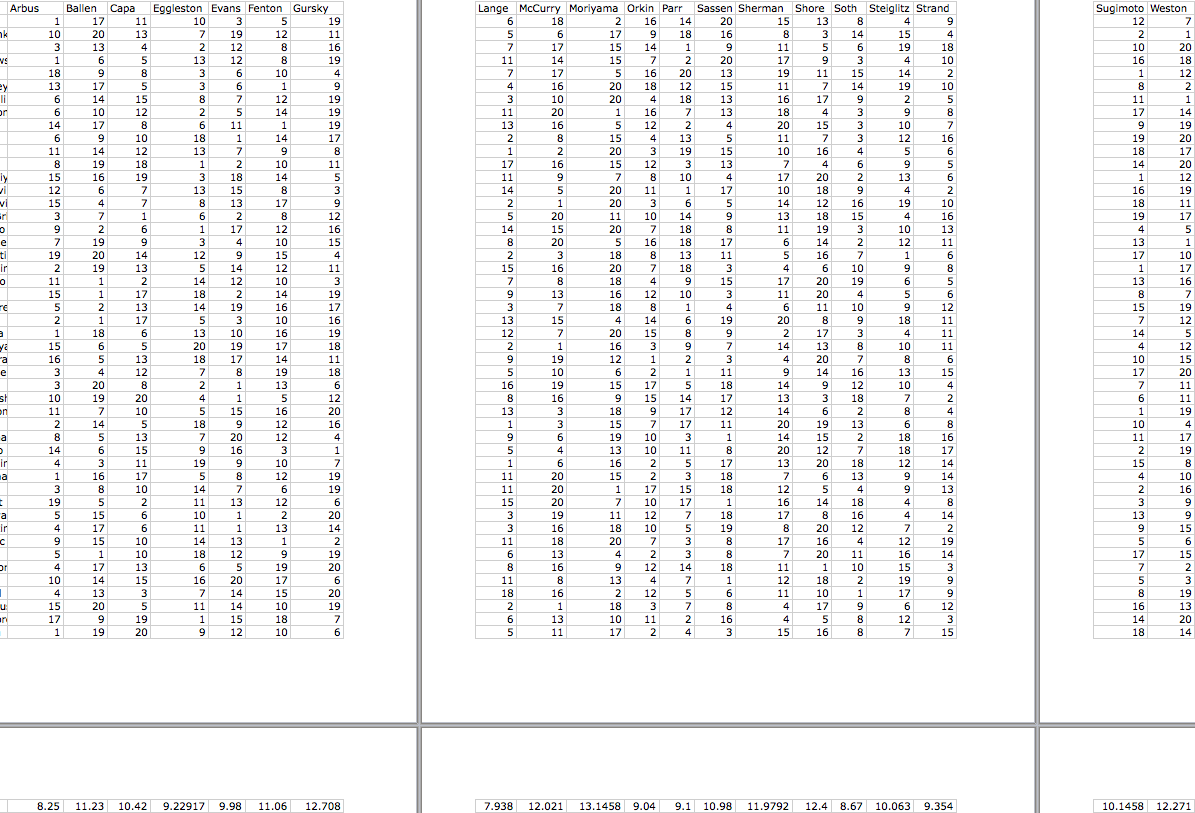
HARD DATA (click to enlarge)

FAVORITES (Names have been removed. Average at the bottom.)


RANKING GUESS (Names have been removed. Negative point total on right. Red zero means an error in the submission (i.e. one name twice and one name not given), however no one with an error would have been able to win based on already having surpassed the winner's accumulated negative point score. xxxx means no ranking guess was made, although a list of favorites was sent by that participant.)


5.25.2012

The Blake Andrews Interview Contest Prize

In Part II of our three part interview with Blake Andrews, we invited him to create a contest, the results to be published both here and on his blog B.

Please take a few minutes and take part by clicking here!

The person who predicts the favorites of all participants most accurately is the winner of the contest. So what do you win?

Blake has dramatically upped the stakes of the contest with this prize offer: he will fly to the city or town of residence of the winner within the next year, photograph the surroundings, and then give the winner a print from the trip.

If the winner happens to reside outside the continental 48 states, the winner will receive a 2012 Cadillac Escalade* with a full slate of options including 5-year / 100,000 mile warranty. (*Prize may be substituted with an item of equal or lesser value to be determined.)

5.24.2012

Interview: Blake Andrews, Part III

© Blake Andrews, Paris, 2010
This is the third of three interview posts with Blake Andrews. Part I can be found here and Part II here. We have a contest connected with this interview that you can take part in by clicking here.

f: The most personally important of your two major influences:

a. Garry Winogrand
b. Lee Friedlander
c. Both

BA: C. Winogrand and Friedlander are definitely two of my favorites, and my style probably reflects elements of both. Winogrand said that every photo is a battle of form vs. content, and I think that's a good lens through which to compare them. Generally Winogrand was more concerned with content and Friedlander with form. That may be an oversimplification but I think there's some truth to it. I think what binds them together, and what connects them to my photography, is that they are / were both very concerned with the photograph as the primary tool of expression. That's in contrast to the current style. Many photographers now put the photograph in a secondary role. It's at the service of some idea. It's an illustrative tool. But for Winogrand and Friedlander, and for me, the photo comes first. You don't know what the idea is until you see the photo. So the photo becomes the way to explore the world, not just the end product of that exploration.

I also empathize with both men because of their work habits. Both were / are absolutely committed to making photos regardless of outside events. Winogrand in particular. I think he photographed as much out of blind compulsion as anything. He just did it because that's what he did, and he felt better afterward, like eating. Or maybe taking a big dump is a better analogy. A huge 20,000 roll steaming dump that someone is going to have to deal with. Because it's fucking important.

© Blake Andrews, Cinemagic Theatre, Portland, 2009
f: You work with humor a lot more (and a lot better) than most photographers that I can think of, and it’s something I have always thought difficult to pull off in photography. Who else do you think works well with humor?

BA: [Elliott] Erwitt is probably the name that pops into everyone's mind first. He is a master of a certain humorous style. In that same vein, some of Kertesz, Doisneau, and Weegee have a humorous edge. More recently there's Kalvar, Mermelstein, and Parr. Those are sort of the platinum humor collection. In the younger crop I like Gordon Stettinius, Michael Northrup, Asger Carlsen, the iN-PUBLiC crew. Some of Chris Verene's photos are funny, especially with his captions. Many of the relatively new reappropriations are great. Champion Pig, Awkward Family Photos, Useful Photography, and stuff in that vein. There's one Tumblr that replaces hands with smaller versions. I mean WTF? That's funny. Sultan and Mandel's Evidence is probably the funniest photo book I own, but it's more absurdist.

I think most photographers steer clear of humor because it's confused with light material. But humor needn't be light. My favorite humor is absurdist, zen koan style. Philosophically that's as deep as it gets. Camus, Sartre, the existentialists, they all bumped their heads against absurdism. Humor doesn't have to be Three Stooges slapstick. Recently I've been enjoying the older episodes of Tim and Eric's Awesome show. It's the most absurd thing I've seen on TV in a while. It constantly bewildering. If someone could convert that brand of humor into photography, I'd buy their book.

© Blake Andrews, Hugo, 2012

f: Talk us through a day of shooting with you. Explain your specific ways of working, your tendencies, particular rhythms and habits.

BA: I don't think there's any typical day. How I shoot depends on where I am and what I'm shooting. When I'm shooting for the Grid projects I am often in residential or light industrial areas without a lot of pedestrians. In Portland I typically shoot the morning after photo meetings. As soon as there is enough light I drive to a new place in the grid, park, and start walking. I generally try to make a loop but the only real direction is toward the new. I avoid streets I've been on already. If I see an alley I generally go that way. If I see commercial activity I'm often drawn to that. I walk for about three or four hours until my legs are tired, shooting pretty much nonstop. Anything that catches my eye I photograph. Usually I can cover most of a grid (2.25 square miles) in three or four visits strung out over the course of a month.

With the Eugene grids I break it up into smaller chunks. I go out for one or two hours several times during the month. Generally the shooting pattern is the same as with Portland grid. I shoot anything that strikes me. I stay in new areas. I want to see it all block by block.

Downtown Portland is where I do most of my urban street shooting, and there my pattern is a bit different. Every week or so I'll park downtown and spend a few hours walking. Often I see gallery shows on the way, so I wind up parking at Blue Sky. From there my "normal" circuit is up Broadway to Pioneer Courthouse Square, around the bus malls and parks and whatever looks interesting, then back down 10th by Powell's through the Pearl back to Blue Sky. What I shoot depends a bit on my mood. I often look for people doing interesting things or wearing interesting outfits. Sometimes I follow them for a few blocks. I always shoot pigeons and car racks. Sometimes I will stake out a corner for a little while if the light is good or there's a good background scene. I know the city very well so there aren't many surprises. But that said, things always change. You never know what will be around the next corner. My shooting downtown is denser than in the grids. I might go through two or three rolls an hour compared to maybe half that rate in the grids. I only shoot the Leica downtown. Whereas in the grids I bring the wider quiver which lately has been Leica, Diana, Yashica TLR, and sometimes a Holga with color.

I don't generally shoot much downtown Eugene. It's pretty dead and there's not enough anonymity or suspense. Sometimes I shoot near the University where there's a lot of foot traffic.

Between all of that shooting is just my normal day to day photography. I always have my camera running errands. Sometimes I shoot from the car, especially if it's raining. And of course at home I shoot my kids and family all the time. Lately I've been exploring my kitchen with a small point and shoot digital camera. Shooting fork tines and food scraps and whatever's around. It's a good camera for getting in close.

But there's no real typical day. I shoot whatever's in front of me, and that's always changing.

© Blake Andrews, East 10th and Burnside, Portland, 2004
f: How would you say you have changed and grown as a photographer over time?

I'm generally looser as a shooter and tighter as an editor. I'm less formal with a camera than I used to be. I used to spend a lot of time lining up shapes and worrying about precision in photos. Now I'm more open to chance and natural flow. I don't want to dominate the moment so much. I want my photos to look more like snapshots than formal landscapes. I want to tap into that thing that can't be tapped into, but you know it when it's been tapped. And that's where the editing comes in. What's been tapped? I'm pickier now about images. I won't print some now that I might have printed before, especially street stuff. It has to have some twist or spark which is fairly rare.

I have more experience looking at other work now. I keep up with what's out there and I think it's made me more skeptical. I'm more open to other photographic approaches but also more picky, more sure of myself. I used to look through the books at Powell's and marvel at all the great photo books that were out there. I wanted so many. Now when I browse the stacks I wonder, "How did this shit get published?" Most of it strikes me as pretentious crap. So I guess I'm more of an arrogant asshole now. At the same time I'm more receptive to a wider range of approaches. I have an appreciation for portraits, for a example, in a way that I didn't just five years ago. So it's a paradox. Go figure.

© Blake Andrews, 42nd Avenue, 2004
f: You have said a number of times you work off Winogrand's motto: “I photograph to see what something looks like in a picture” and that Friedlander taught you that “a photo can be just about visual pleasure with no other burden.” True to these comments, your visual intelligence shows in your work - the combination of two incongruous elements to make a third meaning, plays with geometry, visual puns, the way you line things up and cut things off are unique and impressively developed skills.

Going beyond that, it seems your bodies of images, your writing and even your site push to understand and structure life - via lists, classifications, labeling, pointing out, collecting, and grid projects - and that it’s ultimately about the failure to be able to do so because it’s impossible to fully organize, accurately classify, and keep up with all the images and lists and projects.

My thoughts on your work are:
a. astute
b. horsefeathers
c. something you already thought
d. there’s something to it, but...

 BA: D. I just like making photographs. It's much less enjoyable for me to deal with the aftermath. I know that sounds like a cop-out, but it's just how I am. That said, I am actually quite organized. If you ask me to find a particular photo I can generally locate it quickly. My main organizing technique is by date. Every photo gets a date on the back, along with a few other notes to help me find the negative. But mostly I keep track chronologically. I think this is important not only because dates are vital, but because it says something about my style. All these photos I'm making form a chronological chain. It's a life journal as much as it is anything else. In a way dating simplifies everything. No two photos can happen at once. Every image has a place.

Dates are being erased and that's one of my pet peeves. We're losing our cultural memory. Sometimes I'll load a re-released CD into iTunes and the date comes up as 2005 or something when I know the material was recorded in 1975. To me that's erasing history. It's criminal. I have the same problem with some blogs and Tumblrs. If the posts aren't dated I can't read them. It's just a mishmash. A date provides so much context. Every book I've ever opened I've looked at the date before anything else.

 f: Lastly, what’s next for you, Blake?

BA: One of my dreams since childhood has been to make an NFL roster, so I'm going to give that a crack this fall.

© Blake Andrews, Adrian, Maine, 2001

5.17.2012

Interview: Blake Andrews, Part II

© Blake Andrews, Leo, Zane, Keegan, 2008

This is the second of three interview posts with Blake Andrews. The first part can be found here. The third part will be published next Thursday, May 24th.


f: Alec Soth started off a recent article he wrote on Martin Parr in the Minneapolis StarTribune by calling him the Jay-Z of documentary photography.

BA: I think what Soth was referring to is a sort of hyper-contemporary vibe. Both Parr and Jay-Z seem to have a hand in many cultural outlets nowadays. They almost define contemporary. But also both have a loose experimental quality. Always moving into new territory. And the fascination with bling. Truth is I'm not a huge fan of Jay-Z. I'll take MF Doom over Jay-Z.

f: In respect to your plea for more interactive posts - discussed last week in the first part of this interview - complete the following photographer-musician analogy. Martin Parr is to Jay-Z as Blake Andrews is to  _________.

BA: Woody Guthrie. I'm guessing this relates to my survey from several months back comparing Dylan and Frank. Guthrie for a few reasons. First of all, he was absolutely prolific. Many photographers make a point of never going somewhere without a camera. I suspect Guthrie was like that with his guitar. He carried it everywhere. If he couldn't fit the guitar he at least had a pen and notebook. I doubt there were many days when he wasn't writing songs or lyrics. Second, he was fiercely independent and had a deep suspicion of institutions which I share. I am deeply cynical about corporations, government, and general group-think. Third, he was a bit of a renaissance man. He wasn't just a songwriter. He was an artist, a dad, a writer. And just a good spirit in general. So I admire the guy. I wish he'd written a blog.

I've had a tickertape message on the bottom of my camera for years. It says "THIS MACHINE KILLS FASCISTS" A direct homage to Guthrie.

© Blake Andrews, Laurelhurst Park, 2002
  
f: And as a way to push towards interactive posts, I would like to invite you to make a creative competition for other photographers with me, the results of which we can publish both here and on B.

BA: One competition that I've been curious to try is based on predicted outcomes. You set out 20 well-known photos by famous photographers from a wide variety of types and eras. Then people rank them from most favorite to least favorite, 1 to 20. Then collate, average, and form a general ranking based on all voters. That's the simple part. The second layer is to have people guess at the overall rankings before they're revealed. Perhaps this would happen during the initial voting, or shortly after. Then collate predictions. The person who predicts favorites most accurately is the winner. This would only work with a large enough pool of voters. At least 100 or so.

[This contest is now live! You can participate by clicking here.]

f: You have actively explored the medium itself, working with panoramas, color and black and white, a range of formats and cameras. You have published your images as playing cards and are working on a faux-postcard project. What drives you to expand the range of approaches to photography in this way? Is there something you feel you can do with these explorations that 35mm black and white cannot do?

BA: My camera experiments have typically been winter flings. When the days get shorter and the rains set it, it's not as easy to roam outside with a camera. But I still need to make photos. So I've explored a variety of ways to shoot inside using flash or slow shutter speed or a combination of the two. I've toyed with Noblex, Diana, Holga, digital point 'n shoot, Fuji Instax, etc. The only common denominator is that they're all hand held. They're quick 'n dirty cameras, no tripod, no fuss. Typically I go on a serious bender with a camera and shoot the crap out of it for a few months before the buzz gradually wears off.

That's fine for winter. But during nice weather I kick into high gear and that's basically 35 mm black and white. That's been the core of my work for the past 20 years. It feels right because it rewards experimentation and multiple frames. There's very little penalty for pressing the shutter, as opposed to say 4 x 5. I know that for most people 35 mm is a dead form. It's seen as anachronistic and passe but I can't help it. It's just how I see. If I want my photos to get any attention it probably has to be in another format. So I've tinkered with many methods, but 35 black and white still gives me the most satisfaction. I shoot a few rolls every day from about May through October.

I think whatever you use you need to commit fully to it. You can't be fiddling around wondering what camera to use. It has to be one or the other, and ideally just one lens too. You have to see and think like a camera, and that's hard to do if you're shuffling between several. At least that's my experience.

© Blake Andrews, Main St., Springfield, 2007

f: A related question: you have said in a previous interview that as a child, you thought photography was a mere recording of a scene and because of this you weren’t interested in it. It’s interesting, then, that despite expanding the range of approaches to photography as mentioned above in the previous question, that one of the few lines you do not cross is that line between “straight” and “constructed” photography. What keeps you on this side of that line? Have you ever tried constructing a scene for an image?

BA: I have constructed images for the blog. The postcards, for example, are constructed. I substituted blue skies for grey. For applications like that or for commercial applications I think constructing images is fine. But for examining the world, which I think photography does very well, constructed images aren't very interesting to me. They don't show the world so much as they show what's in someone's mind. Nothing wrong with that. I'm just more interested in the world. And that applies to other forms too. I only read nonfiction. I generally prefer documentaries to fictional films. I guess I have my quirks.

© Blake Andrews, Edgewood, Eugene, 2008

f: In a Wired article on photobloggers, you also mentioned what you’d like to see less of in the photography world: “Less 6 x 7 aspect ratio color photos of the human-nature interface delicately composed, with everything in focus; less portraiture with desaturated colors; less perfectionism; less constructed images and more found images; less commercial advertising on blogs; and less equipment talk.” Building from this previous list, please list the 10 most painful trends in contemporary photography in 2012, in reverse order from 10 to 1 with 1 being the most painful.

BA: I will probably get in trouble here. First of all, everyone is totally free to do what they want. As with any Top Ten list, please take these with a grain of salt.

10. The widespread inability among practitioners to differentiate an average print from a great one.

9. Thought before seeing. It should be the other way. Shoot first, ask questions later.

8. Conscious perfectionism and unconscious imperfections.

7. Film growing more expensive as it gradually phases out.

6. The planned obsolescence of most cameras in use now, and the correlating obsolescence of work being made with them.

5. Neo-pictorialism. I am all for shooting Holga / Diana / Instagram, as long as the material isn't sappy. But when blurriness combines with an overly sentimental vibe, it feels like something that was done, and better, 100 years ago.

4. Photos without credits attached. Every photo printed or online should include some reference to the creator's name. I'd guess that less than half actually do.

3. The idea that everyone's a photographer. Everyone has a thermometer in their medicine cabinet. That doesn't mean we're all doctors.

2. The conflation of a photographer's life story with their images in assessing aesthetic merit.

1. Homogenization. In photography as well as in the broader culture, homogenization is the most powerful, evil force we face. All 7 billion of us are unique. Be yourself.

© Blake Andrews, San Diego, CA, 2007

f: And what gives you optimism for the photography world today?

BA: 10. The ocean of photographic archives currently being put online by various public entities. A very powerful resource in all sorts of ways, some not even thought of yet.

9. Street photography's apparent revival. Possibly a reaction to photography's hyper-conceptual direction.

8. Cupertino. Post. Applesauce.

7. General improvements in color printing over the past decade. Forty years ago good color prints were generally inaccessible. Now they can be made by anyone.

6. Looking forward to the return of Jesus Christ my lord and savior. I'm expecting him to help me fine tune my portfolio.

5. The decreased environmental impact of picturemaking. The marginal cost to the environment of taking a digital snapshot is virtually zero compared to the age of paper and chemicals. Of course the planet is already fucked anyway so I'm not sure it matters much in the end.

4. The decline of matting in galleries. It's about time we phased out this Victorian relic. Maybe glazing will be next.

3. The idea that everyone's a photographer. Never has photography been more accessible to all. Moholy-Nagy said "the illiterate of the future will be the person ignorant of the camera as well as the pen." I think we have finally, only quite recently, arrived at that future.

2. The photobook renaissance. These are the glory days of photobook publishing.

1. Every time I press the shutter I'm an optimist. The idea that the next image will be special is what keeps me going.

© Blake Andrews, SE 45th and Adler, 2004


Part III can be found here

5.10.2012

Interview: Blake Andrews, Part I

Blake Andrews, Emmett, 2011

This is the first of three interview posts with Eugene, Oregon-based Blake Andrews, a photographer and member of iN-PUBLiC. He runs the photography blog B and is also involved with the Portland area photography groups Lightleak and Portland Grid Project. The second part will be published next Thursday.

Blake’s early history, experiences with iN-PUBLiC, role as a photoblogger, thoughts on street photography as well as influences both contemporary and historic have been covered fairly thoroughly in interviews here, here, here, here, and here.

The following questions attempt to complement these previous interviews and you may enjoy reading one or all of them along with this one.

fototazo: I have one question for you on the blog: what kept you working on it as many others dropped theirs?

Blake Andrews: That's a good question, and well-timed too because my blog is actually now on indefinite hiatus. But during the 4+ years I kept the blog current, the main thing that kept me going was just sheer enjoyment. I like writing. I like trying ideas on for size. At a certain point the blog gained a level of inertia. It had a momentum of its own, and so I had to feed it every day. And the pouring out of ideas on one end seemed to help ideas generate on the creative end, like a siphon hose. It was there every morning staring at me like a hungry lion. Feed me.

In its last year or so the blog evolved for me into a sort of art project. I wasn't interested so much in writing expository essays as toying with the whole form. I was asking, what the heck is a blog? What is it expected to look like and why? How can it be different? So that's what generated a lot of the recent experimentation, changing headers every day and making up new profile locations and colors, and all the polls, and making the background fade like an old newspaper. I went through a long series where I gave each post a song name, and I named posts after photo books, and posted things upside down or inside out or whatever. Anything to just try something different, to keep myself entertained, to make myself laugh. When I'd write posts that made me laugh out loud that's when I knew I had something good.

Gradually I wound up creating this online persona. B is sort of a crazy cynic. I suppose there's a part of me that's like that, but in many ways it's not me at all. I'm actually a nice guy. I'm shy. But for whatever reason I carved out this territory online where I'm a weird photo-geek who'll say just about anything. And I've probably sabotaged any hope of a fine art photo career in the process. So be it. But it is troubling that people know me as a blogger rather than a photographer. People reading my blog might call for me to be committed, but the truth is I'm very committed, as a photographer.

Blake Andrews, Eugene, 2005

I guess what it comes down to is I'm not really a critic. I feel silly cranking out some educated-sounding critique about a photo project or trends or whatever. Who am I to be an authority on any of that? But what I am an authority on is my own life, and so I tried to root the blog in personal exploration. Every post had at least one subtext, and often two or three, many of which only made sense to me. It became a sort of scientific workbench, a place to dissect and recombine ideas. But in the end it was mostly for me. I often felt a disconnect with readers, like I was saying one thing and they were reading something else. The posts which really made me laugh rarely received comments.

In the past year the blog began to feel more like an obligation and less organic. If I didn't write something for a day or two, I felt like I was letting folks down. I started to track hits, page views, comments and a lot of other meaningless crap, just to try to gauge who was reading. Why did they read it? What did they want? When I found myself worrying about that stuff I knew the end was near. My post about dead photoblogs last December was a premonition, but it was unconscious. I didn't realize at the time that I was writing about myself.

A main problem since the beginning is that my blog has gotten in the way of my photography. I have many photo projects that I want to pursue and a certain amount of free time. But as long as the blog was around, it's what received my energy. Ideally there should be a way to do both, to pursue projects and keep a blog up. If I could do the blog as a little side thing and just write one post a week it would be great. Some people can do that, but I've found that style doesn't work well for me. If I'm not writing every day my posts don't have the right snap. In order to write well or perform any task really I need to get sort of obsessed. And I was obsessed with B. But it was keeping me from getting obsessed with my own photography. So on March 1st I decided to go cold turkey and put it on hold for a while. At first I just thought I'd leave it for a few weeks. I've done this before a few times when I needed to recharge and always resumed blogging. But I'm really enjoying the time off so I may extend it indefinitely. We'll see. I honestly don't know what's going to happen. It's really up in the air. I've been tinkering with it a bit lately, slowly lightening the text every few days, letting past posts fade into the blank page. I think that might be a good way to end it.

One of my projects while my blog is down is to compile B's archives into a series of Blurb books, not for sale but just to allow me to make a hardcopy of what I've done. I got freaked recently when I read that Too Much Chocolate went offline not because of a creative decision but because it'd been hacked. Someone got in and sabotaged the archives. Which really sucks, and would suck if it happened to B. Right now all if it exists only online. So I'm making a hard copy which will wind up being four books of roughly 350 pages each. Booksmart can get them into rough form but they still require some tweaking, so I'm in the process of editing now. It's been fun going through old posts and seeing the gradual changes over time. Once I get the raw posts printed I want to put the best ones into one volume for iPL.

That's one project. I have several others, but I'm not really ready to discuss them.

f: During your year of experimenting with B, did you come to any conclusions on what a blog does best? Or what its limits are as a format?

2.10.2012

Reading Shortlist 2.12.12

The Reading Shortlist is an occasional post with a listing of recommended readings and links. A recommendation does not necessarily suggest an agreement with the contents of the post. For previous lists, please visit the site links page.


Blake Andrews, B, Reject. Andrews on his vast personal collection of rejection letters, his new approach to show applications, whether or not this is all worth it, and a copy of Robert Frank's Guggenheim application for good measure.

Sharon Boothroyd, Photoparley, Marc Feustel on Social Media. eyecurious' Feustel on the decline of photoblogging, on the impact of blogs on the exposure of new talent, and on the online photographic community.

Pete Brook, Wired, In Digital Age, Sourcing Images Is as Legitimate as Making Them. Photographer Paul Shambroom talks about his motivations for moving from his long and distinguished career making large-format images on America's infrastructure to working with found online images.

Featured Speaker John Gossage / SPE Conference at Light Work. An hour long lecture by Gossage that's part of the excellent SPE Conference lecture series that also includes talks by Ken Schles and Thilde Jensen as well as a roundtable hosted by Andy Adams about Photography 2.0.


Richard Mosse, Pulitzer Center on Crisis Reporting, Through the Glass Brightly: Eastern Congo by Infrared. An excerpt of Mosse's essay from his new book, Infra. A powerful and well-thought through essay that serves as a model for anyone looking to work on their statement.

Claire O'Neill, NPR's The Picture Show, Deborah Luster: The Power of a Picture. An audio conversation with Luster who began photographing prisoners in rural Louisiana as a way to make visual one of the reasons the local countryside had become de-populated and as a way of coping with her mother's murder.


Colin Pantall, Introspective, navel-gazing nitpickers. Pantall on the problems in the contemporary photobook market and in the consumption of photobooks, especially the tendency to blindly follow tastemakers.

Adriana Teresa, New York Times Lens Blog, A Moment With Larry Fink. Teresa, co-founder of FotoVisura and publisher of Visura Magazine, conducts a interview with Fink that's biographic and that also includes questions on Fink's specific projects.

11.14.2011

The Image: Blake Andrews, "Saturday Market, Portland"

© Blake Andrews, Saturday Market, Portland, 2007

Blake Andrews: I made this photo at the Saturday Market in Portland a few years ago. I am sort of a sucker for caricature booths. Whenever I pass one I tend to stop and peer in. Drawing is a difficult skill, so I like to see how well the drawing matches reality. Also there are sometimes good photos to be had, since the attention is usually on the sitter and no one pays much mind to a nearby photographer. It's open season for shooting.

The woman in this booth was having her portrait drawn with a dog on her lap. If I were a few feet closer you could see the dog. But from where I've chosen to make the photo the dog can't be seen except in the drawing. The man holding up his hand is waving to the dog, trying to get it to look up. Since the lady doesn't look like the drawing, there's a visual disconnect which I find amusing. You wonder what the heck is the artist looking at? That's basically the crux which holds the photo together. But I also like how the smaller elements surround the scene, all the faces looking toward the viewer, and the various drawings, scaffolding and deep space off to the left which fills out the picture.

It's a bit of a self-referential photo, an image about image-making and the problems inherent in documenting anything. And that extends to its interpretation. Although this is one of my favorite photos, few people like it, I think because they have a hard time interpreting what's happening. Winogrand was right. Nothing is as mysterious as a fact clearly described.

11.02.2011