Showing posts with label Daniel Echevarría. Show all posts
4.17.2013
Profile: One, One Thousand
Today we profile the site One, One Thousand through a Q&A with co-founder Daniel Echevarría. Echevarría is a photographer and editor who lives and works in Atlanta, Georgia.
fototazo: Why did you decide to start One, One Thousand? Where does the name come from?
Daniel Echevarría: We conceived of the idea for One, One Thousand in early 2010, but the actual site didn't go live until the end of that year. Co-founder, Natalie Minik, and I had both moved back to Atlanta, and we were struggling to find artistic opportunities in the city. We wanted to create a platform for Georgia photographers to share their work. As we continued discussing the limitations present to photographers living outside of the United States' major art markets, we decided to expand our plan to cover the entire southeast.
In my opinion, southern photographs—and even more specifically southern photographers—don't always receive adequate recognition. We wanted One, One Thousand to become part of a solution to that problem. The idea was to feature photographs, create some semblance of a regional community, and also to archive much of the great work being created in the south.
The name "One, One Thousand" doesn't have anything to do with the south. While reading the foreword to Josef Albers' "Interaction of Color," I learned that Albers was particularly fond of a quote by the Victorian art critic John Ruskin: "The greatest thing a human soul ever does in this world is to see something, and tell what it saw in a plain way. Hundreds of people can talk for one who can think, but thousands can think for one who can see. To see clearly is poetry, prophecy, and religion, —all in one." We think of the photographers on our site as those "ones in thousands" who can actually see.
f: Has running the site affected your sense of what "southern photography" is? Have you come to any conclusions as to tendencies, traits, or connecting elements that are more prevalent in photography of the region than in other parts of the US?
DE: When we started the publication we didn't really know what to expect from "southern photography." Part of the reason we felt compelled to build the site was our limited knowledge of contemporary work in the region aside from some of the big-name artists like William Eggleston, Sally Mann, William Christenberry, etc. There really wasn't anything similar yet online addressing the subject. We had to get our hands dirty and research the photographers, projects, and organizations that had interests in the southeast. As the site initially grew, we tried to approach everything without any preconceived notions.
For the most part, my definition of southern photography remains very open-ended. I live in a region that is constantly transforming, with a steady influx of immigrants and people from different parts of the US. Add to that the advances in technology and information distribution in last few decades, and this really ain't your mama's South. I think current southern photography reflects the South's changing dynamics in the 21st century. William Eggleston might have said it best, though, when he was asked about the topic: "I've had the idea always that it shouldn't be approached as pictures of the South. People down here get carried away by romancing the place."
Nevertheless, I'd be lying if I denied noticing some trends during the past two years editing the site. I wouldn't go so far as to claim that certain themes currently dominate southern photographic practice, but photographers are definitely exploring similar ideas in unique ways. If you looked through a random sampling of the projects featured on One, One Thousand, you'd most likely find a few dealing with a search for home, a return to one's roots, or an attempt to understand place autobiographically. There are people much smarter than I am who probably have or should devote some scholarly research to these works. I can, at the very least, understand the desire to take on this subject matter because like so many other photographers in the region, I left and came back.
f: Do you feel that a photograph or photographic project produced by someone who lives in the South that doesn't relate to the people, history, or landscape of the region and instead focuses on themes that are more universal is still in some way "Southern" and part of the definition of Southern photography?
DE: I think I partly answered this in the last question, but if you need a pointed response, then, yes. It was never my intention to make One, One Thousand specifically about "southern" themes, but instead to examine the region by means of the actual work being created here. Richard Lou (who was featured on the site in August 2012) told me he thought One, One Thousand was a "creative asset map," and I think he hit the nail on the head. One of our goals was to make a resource so both photographers and the general public could see the great variety of work and the talent pool currently in the southeast. We do accept work by people who live in other regions of the country, but we primarily publish regional artists. In the past it's sometimes been a challenge to highlight more "universal" work, but I think that the longer One, One Thousand is around, the more diverse the collection of work on the site will become. I always encourage everyone regardless of style, content, or theme to submit.
f: What are other institutions, online sites, galleries and magazines that people should know about that deal particularly with Southern photographers?
DE: One of the personal joys of editing the publication has been the educational aspect. When I started out, I could have only told you a few organizations, but now I can give you a pretty big list. Since One, One Thousand was founded, I've noticed growing online activity surrounding the subject of southern photography (a couple of new publications have even sprouted up in the past year or so). Maybe it's just my increased consciousness, or maybe we're coming to the fruition of some sort of modern southern photography movement? Who knows, but here's a very brief list of organizations people should look up (One, One Thousand's links page is much more exhaustive if anyone is interested):
Institutions: The Ogden Museum of Southern Art (New Orleans, LA)
Galleries: Rebekah Jacob Gallery (Charleston, SC) Candela Books + Gallery (Richmond, VA)
Festivals: PhotoNOLA (New Orleans, LA) Atlanta Celebrates Photography (Atlanta, GA)
Online sites: Southern Photography: The Blog about Fine Art Photography in the American South by John N. Wall Walk Your Camera by Roger May (specifically the "Looking at Appalachia" series
Independent Book Publishers: Candela Books (Richmond, VA) Fall Line Press (Atlanta, GA)
f: Point us towards some photographers from or based in the South that you are interested in currently.
DE: I think all of the photographers featured on One, One Thousand are more than worthy of increased attention and interest, so I'd point you to any of them without a second thought. I understand that's not really a satisfying answer, though, so here are 3 southern photographers who continue to surprise me and who I eagerly look forward to seeing their new work: Deborah Luster, Mark Steinmetz, and Susan Worsham.
f: Where is the site going? What are your plans for 2013?
DE: It almost feels like 2013 is going to wrap up before I can fully deliver on many of the plans I had for the site at the beginning of the year. This isn't my full time gig, so it's always difficult to manage work, artistic ambitions, personal life, and leave time for One, One Thousand. Still, it's a labor of love and I'm always tinkering, trying to make it better.
A big change in the last year has been the lower frequency of blog posts highlighting photo shows, grant opportunities, photography books, etc. That kind of information can more easily (and perhaps even more effectively) be shared on social media. I generally want the website's non-photography pages to include more nuanced and long form articles and series. I've also begun collaborating with universities to feature more student work, and I'm interested to see how that keeps going.
Another goal is continuing to grow our audience. I always knew that southern photography was going to attract a somewhat niche community, but the work on the site truly deserves to be seen by more eyes.
In terms of the website's backend, I'm currently working with an excellent developer and friend, Ben Brodie, to update One, One Thousand for Web 2.0. I'm hoping for greater functionality on desktop and mobile, and just a better user experience overall. One, One Thousand was always designed with the web in mind, and as that medium changes, we have to change with it.
6.08.2012
The Blake Andrews Interview Contest Final Results
Votes are tallied, results are in for the Blake Andrews Interview Contest.
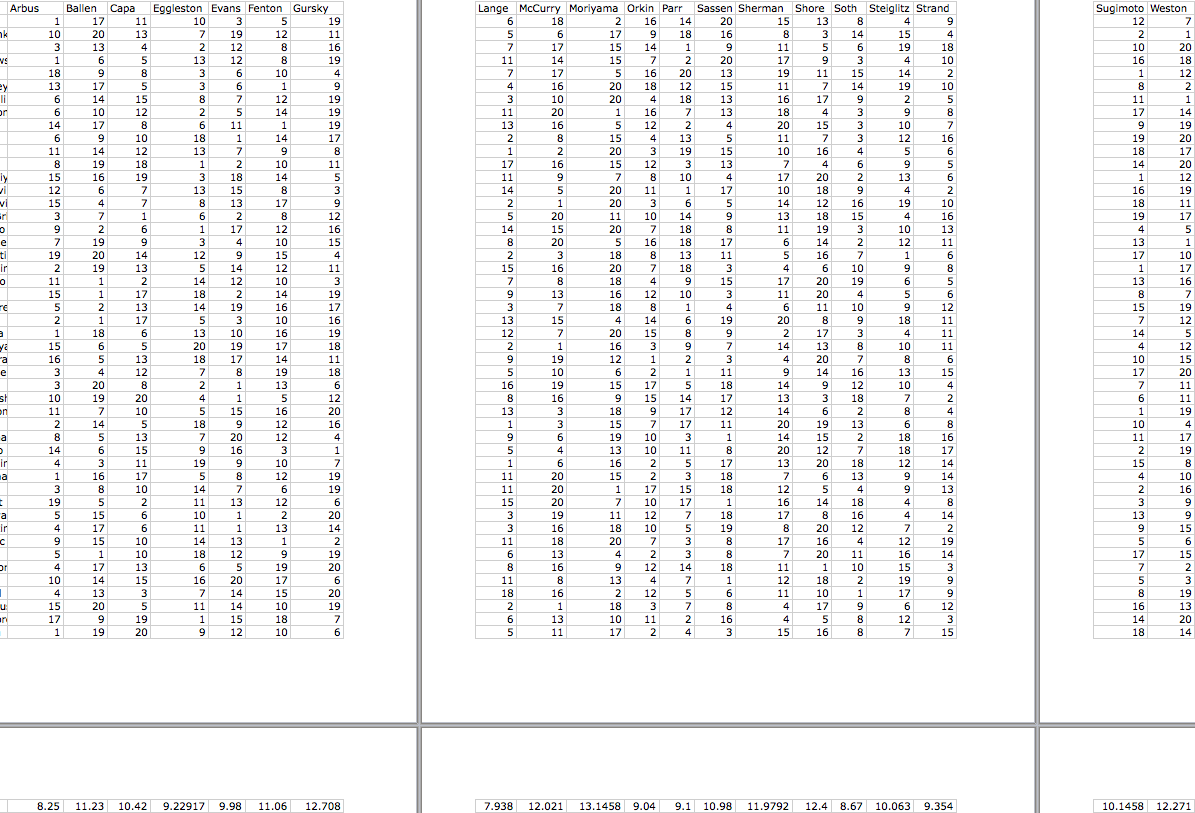
The contest involved participants ranking the above photos in order from favorite to least favorite. The second part involved guessing the overall averaged ranking order of all participants. More on the contest guidelines can be found here.
Results were counted as follows: if, for example, a participant ranked Ruth Orkin's photo as 15, and its real order in the averaged ranking was 10, the participant received -5 points. The points were then added for all 20 images to give the participant a total negative point score. The winner was the participant with the smallest negative point score.
Before announcing the winner, let's count down the final averaged image rankings, from least favorite to favorite.
20. Daido Moriyama - Moriyama's image was voted least favorite collectively as well as by nine (of 48) participants. (Averaged Ranking: 13.15)
19. Andreas Gurksy - Rhein II sold for $4.3 million dollars in November 2011. It would apparently be hidden in the closet by the majority of voters, taken out and placed on the mantle just before Andreas stops by. (AR: 12.71)
18. Stephen Shore - This ad for Chevron by New Topographer Shore wasn't popular either. (AR: 12.40)
17. Edward Weston - Weston's portrait of John Coplans didn't resonate with participants. (AR: 12.27)
16. Steve McCurry - One of the most divise images in the ranking in terms of range; hated by many, loved by few, averaged low. Interestingly, it ranked first just as many times as our eventual winner (3 times). (AR: 12.02)
15. Cindy Sherman - One of only two images with no first-place votes. (AR: 11.91)
14. Roger Ballen - Voters did not rate highly this Ballen image of two characters from Matthew Barney's Cremaster cycle. (AR: 11.23)
13. Roger Fenton - The lack of participation by Crimeans in our contest surely kept this image from rising higher. (AR: 11.06)
12. Viviane Sassen - (AR: 10.98)
11. Robert Capa - Share's the averaged average photo award with Sugimoto. (AR: 10.42)
10. Hiroshi Sugimoto - Share's the averaged average photo award with Capa. (AR: 10.15)
9. Alfred Stieglitz - Begins a run of nine consecutive American photographers in the top nine spots. (AR: 10.06)
8. Walker Evans - This cornerstone image of American photographic history ranked overall towards the middle, but it did, however, tie for the most number of first-place votes with five. (AR: 9.98)
7. Paul Strand - Strand's image of Lilliputians on the set of Guillver's Travels: Mini-Mayhem in Manhattan was one of only two images with no first place votes along with Sherman. (AR: 9.35)
6. William Eggleston - Shaquille O'Neal's childhood tricycle ranked quite highly with participants, but fell from four to six on the last night of voting. (AR: 9.23)
5. Martin Parr - Parr begins a run in the top five of images with figures, four of them being portraits. (AR: 9.10)
4. Ruth Orkin - (AR: 9.04)
3. Alec Soth - (AR: 8.68)
2. Diane Arbus - This portrait of Blake Andrews and his family by Diane Arbus ran neck and neck with our winning image until the last day, but faltered at the finish. Tied with Evans for the most first-place votes with five. (AR: 8.25)
This leaves our favorite collective image as...
1. Dorothea Lange - Lange won by being average. She was only ranked first by two participants, but only three had her below fifteen - and she was ranked last by no one. The great majority had her image in the three to eight range. The winning combination for making a favorite image appears to be to offend no one while appealing just enough to all. (AR: 7.94)
So what to make of the results? I'd love to see a public conversation develop around them.
As Blake mentioned in an email to me, the rankings were fairly closely clustered in terms of first to last, more so than expected. The high rankings of American photographers and portraits seems notable to me at a glance through the rankings. I had thought there might be a bias towards color, but apparently not.
As I guess one would expect, the top few images generally were the least divisive - few people ranked them very high or low, most ranked them upper middle. This fits my experience being on juries for photography competitions. It's usually the average image (no offense, Ms. Lange) that we can all agree on that wins.
______________________________
On to our guessing and to our winner.
We received 48 completed entries. Our winner? It wasn't very close.
Daniel Echevarría, photographer and co-publisher of the blog One, One Thousand apparently has a supernatural understanding of our collective psyche. He won with a negative total of -69. Our last place finisher, for context, finished with -163.
I asked him about his ranking strategy and he replied: "I based my ranking guesses on the current popularity of these photographers, trends in the photo-world, and what I believe to be a universal consensus that Rhein II should have sold for $430 and not $4.3 million. The fact that I have a doctorate degree in soothsaying probably also helped."
Blake Andrews, in accordance with our previously announced prize, will be flying to Danny's current city of residence - Atlanta, Georgia - sometime within the next year to photograph. He will give Danny a print of an image made during the trip.
Danny also saved Blake and I from some collective embarrassment, public scrutiny, character assassination, released hounds, pitchforks, torches, tarring, feathering and extended reflection on our methodology - I finished second and Blake finished third, tied with fellow iN-PUBLiC member Amani Willett.
Thank you to everyone who sent in an entry and for taking part in the contest!
HARD DATA (click to enlarge)
FAVORITES (Names have been removed. Average at the bottom.)
RANKING GUESS (Names have been removed. Negative point total on right. Red zero means an error in the submission (i.e. one name twice and one name not given), however no one with an error would have been able to win based on already having surpassed the winner's accumulated negative point score. xxxx means no ranking guess was made, although a list of favorites was sent by that participant.)
Tags:
Blake Andrews,
Daniel Echevarría
2.17.2012
Photographers on Photographers: Thomas Roma by Daniel Echevarría
![]() |
| © Thomas Roma |
In one of my favorite quotes about art, the 19th century critic, John Ruskin, describes the importance of seeing. He writes, "The greatest thing a human soul ever does in this world is to see something, and tell what it saw in a plain way. Hundreds of people can talk for one who can think, but thousands can think for one who can see. To see clearly is poetry, prophecy, and religion — all in one." The essential goals of any visual artist in seeing and creating shouldn't stray too far from Ruskin's valuation. To eventually see properly, though, requires more than just wandering and lucky eyes — I believe seeing requires discipline, training, and study.
Over the years (and so far as my budget has allowed), I've had the opportunity to build a small but nevertheless personally beneficial photobook library. Each book, in its own way, is an invaluable reference. My collection includes a few rare and out-of-print titles, most of the books are first editions and signed, almost all are in pristine shape. But one is bent with a split spine, coffee-stained, pages wavy and earmarked, and that's how I know it's the most important book on my shelf — the one I've used the most as a guide on how to see.
I received a copy of Thomas Roma's Found in Brooklyn as an unexpected gift from a professor during my Introduction to Photography course in my second year of university. At the time, I had no intention of practicing photography other than as a passing interest. I had recently moved from the suburbs of Atlanta, Georgia, to New York City, and I was studying print journalism and history. Photography was always a hobby, but it wasn't until I was enrolled in that class (taught by the extraordinary photographer and teacher Anibal Pella-Woo) that I even considered the idea of photographing seriously. Pella-Woo handed me a shrink-wrapped copy of Found in Brooklyn one day after class, and he said that judging from the photos I had presented, I might enjoy Roma's work.
![]() |
| © Thomas Roma |
Years later, it's difficult to write anything too analytic about the photographs in Found in Brooklyn. I feel I've seen them so many times, I've internalized and personalized them. Writing about Roma's pictures is like trying to explain to a stranger why week after week you still get drinks at the same bar sitting in the same stool with the same friend with whom you typically have variations on the same conversation. Still, it's through this sort of comfort that you can sometimes learn the nuances of a person, or work, or even yourself.
Although I didn't grow up in New York, the Brooklyn I saw in Roma's photographs (a Brooklyn that was at times almost 20 years younger than the one I first witnessed) was the Brooklyn with which I immediately connected. Roma's Flatbush is a lovely and chaotic mix of cyclone fences, exposed electrical wires, clotheslines, imitation Greek statues, and graceful shadows, all constantly at play with each other. I might not have actually wanted to live in this neighborhood, but I knew I'd be happy living within any of those pictures' edges. In the introduction to Found in Brooklyn, Robert Coles writes that Roma is a "poet of the camera, a localist poet" who gives us "what he 'found,' the soul of a place as it is, and as it gets lived daily." I couldn't agree more. What Roma created is a succinct but expressive distillation of the characters and characteristics of a specific place at a specific time.
![]() |
| © Thomas Roma |
Much has been made of the link between Roma's Found in Brooklyn and William Carlos Williams' poem Paterson (even Roma explored the artistic connection through his later book House Calls with William Carlos Williams, MD). I suppose there is a good deal in common with Found in Brooklyn and Paterson, but the difference in scope of the two works never quite allowed me to fully accept the comparison. In Williams' five book poem, New Jersey's Paterson is both a city and a not-so-abstract allegory of the prototypical modern man. The focus of Roma's Flatbush is a bit narrower — which is not to say it isn't as effective — and accordingly, Roma's photographs emit a special immediacy and intimacy to their viewers. These are transcendent photographs of ordinary people, ordinary buildings, and ordinary nature.
![]() |
| © Thomas Roma |
When I lived in New York, I visited Flatbush a few times hoping to catch glimpses of the neighborhood I knew so well from Found in Brooklyn. I especially wished I could find that convertible parked at the gas station. I wished I could invite myself for a ride with that blonde basking in the passenger's seat with the summer sun pouring over her (or at the very least, console myself with a warm loaf of bread from Santo's truck after my swift rejection). But the truth is, I never saw what Roma did, and that's because I still don't see as well as he can. Maybe after I study this book a thousand more times, I'll be a few steps closer to seeing clearly myself.
Daniel Echevarría is a photographer and the co-founder and co-editor of One, One Thousand | A Publication of Southern Photography. He lives and works in Atlanta.
8.12.2011
f100: Ray Mortenson, Ángel Franco, Tammy Mercure, Greg Miller
![]() |
| © Ray Mortenson, Untitled, 1983 |
fototazo has asked a group of 50 curators, gallery owners, blog writers, photographers, academics and others actively engaged in photography to pick two photographers that deserve (more) recognition - the underknown, the under-respected as well as not-appreciated-enough favorites. A little more information on the project is available in the first post in the series here.
Today we continue the series with responses from Daniel Echevarría and Natalie Minik.
We began the series with responses from Nicholas Nixon, Matt Johnston, Blake Andrews, John Edwin Mason, Aline Smithson, Colin Pantall, Michael Werner, Liza Fetissova, Laurence Salzmann, Bryan Formhals, Richard Mosse, Shane Lavalette, Amy Stein, Amani Willett, Wayne Ford, S. Billie Mandle, Leslie K. Brown, Gordon Stettinius, Marc Feustel, Hin Chua, Adriana Rios Monsalve, Daniel Augschoell, Larissa Leclair, Elinor Carucci and Pieter Wisse.
Respondent: Daniel Echevarría is a photographer and the co-founder and co-editor of One, One Thousand | A Publication of Southern Photography. He lives and works in New Orleans.
Selections: Ray Mortenson and Ángel Franco
Ray Mortenson
In recent years in the United States, we've seen a proliferation of photographs of urban blight (symptomatic, perhaps, of the nation's anxious psyche during this increasingly long recession). Photographs of depressed cities from across the Rust and Bible Belts have been both praised and derided as "ruin porn." Call them what you will, these kinds of photographs aren't going way - and they shouldn't. However, I do think many photographers would benefit from taking a more retrospective approach to this subject matter. Here's a good place to start looking: Ray Mortenson's photographs of the South Bronx from 1982-1984. Mortenson wisely refused to engage in nostalgia, instead focusing on the Bronx's textures, shapes, and shades.
![]() |
| © Ángel Franco |
Ángel Franco
From 1979 to 1984, Ángel Franco photographed crime scenes in the Bronx's 46th Precinct. Comparisons can easily be drawn between Franco and Weegee, but Franco's naked city is undeniably more violent than his predecessor's. These are raw and powerful photographs that deserve a much wider audience.
Respondent: Natalie Minik is a photographer and the co-founder and co-editor of One, One Thousand | A Publication of Southern Photography She currently lives in Durham, NC where she attends Duke University for her MFA in Documentary and Experimental Art.
Selections: Tammy Mercure and Greg Miller
![]() |
| © Tammy Mercure, Pigeon Forge, TN, 2009 |
Selections: Tammy Mercure does an excellent job of capturing the kitsch people find interesting about the South. She is able to see past the prefabricated photo-op moment and get to what is most interesting about these tourist destinations. Most of all, she is respectful and accurate in the way she handles the subject matter. That's why I think she deserves more credit.
Whether Greg Miller photographs a country fair or Ash Wednesday, he captures the interior life of his subjects. His fair stance on people makes his photographs regal yet lonely. This is why I never tire of looking at his images.
![]() |
| © Greg Miller, Untitled, from the series "Ash Wednesday" |
Subscribe to:
Posts (Atom)